

Business Valuations
Understand what your business is truly worth — and why.
Whether you are selling a business, buying out a shareholder, raising finance, planning succession or simply wanting clarity on value, Verance provides independent business valuations tailored to your exact circumstances.

5-Star Google Rated

Signed off by a CIMA Professional – (CGMA)

Nearly Two Decades of Corporate Finance Experience

International CFO as a Service Network Partner

South African Representative of Peak Consulting GmbH
What Is a Business Valuation?
A business valuation is the process of determining the economic value of a business or ownership interest at a specific point in time using recognised financial methodologies and professional judgement.
A valuation considers far more than simply historical profits or assets. It assesses the business’s ability to generate future distributable cash flows, the risks associated with those earnings, the strength of its assets and liabilities, market conditions and strategic operational considerations.
The outcome is typically expressed as either a single fair value estimate or a reasonable valuation range, depending on the purpose and context of the valuation.
Businesses derive value from their ability to generate future economic benefits for their owners.
These benefits may come from future profits, cash flows, intellectual property, customer relationships, brand reputation, market position, beneficial tax structures, specialised expertise, contracts, strategic assets or growth opportunities.
Even businesses that are currently loss-making may possess significant value if they own valuable assets, intellectual property, customer relationships or strong future growth prospects.
Ultimately, the value of a business reflects what informed parties may be willing to pay today in exchange for the future benefits they expect to receive from owning it.
One of the most common misconceptions in business valuation is the difference between Enterprise Value and Equity Value.
Enterprise Value (EV) represents the value of the entire operating business, regardless of how it is financed. It includes both debt and equity providers’ interests in the business.
Equity Value, on the other hand, represents the value attributable only to the shareholders after accounting for interest-bearing debt, excess cash, shareholder loans and other funding arrangements.
In simple terms: Enterprise Value less Net Debt equals Equity Value.
Understanding this distinction is critical when negotiating acquisitions, shareholder transactions and investment deals.
Not all shares in a business carry the same value.
A controlling shareholder often has the ability to influence strategic decisions, appoint management, approve budgets, distribute dividends and determine the future direction of the business.
Minority shareholders generally have fewer rights and less influence over decision-making and may therefore experience discounts in value compared to controlling interests.
The size of any control premium or minority discount depends on factors such as shareholder agreements, voting rights, governance structures and the degree of influence attached to the ownership stake being valued.
Market Value reflects the value that would typically be expected between a willing buyer and willing seller acting independently and without compulsion.
Strategic Value represents the additional value that a specific buyer may be willing to pay because of synergies, competitive advantages or strategic benefits unique to that buyer.
For example, a competitor may be willing to pay more for a business because it provides access to new markets, customers, products or operational efficiencies. As a result, the strategic value of a business can often exceed its standalone market value.
Although often used interchangeably, Fair Value and Fair Market Value can have different meanings depending on the valuation context.
Fair Market Value generally refers to the price that would be agreed between a willing buyer and willing seller in an open and unrestricted market.
Fair Value is often applied in shareholder disputes, litigation matters and accounting standards where adjustments may be made to ensure equitable treatment between parties.
The specific definition adopted can materially influence the valuation outcome and should always be clearly defined at the outset of an engagement.
Businesses are sometimes worth more to certain buyers than they are on a standalone basis.
This additional value is commonly referred to as a strategic premium and is usually driven by expected synergies following an acquisition.
Examples include:
- Elimination of duplicated overhead structures.
- Access to new customers or geographic markets.
- Cross-selling opportunities.
- Improved purchasing power.
- Operational efficiencies.
- Increased market share.
- Access to intellectual property or specialised capabilities.
These synergies may justify acquisition prices significantly above traditional valuation benchmarks and are often observed in merger and acquisition transactions.
When Do You Need a Business Valuation?
Selling a Business
A business valuation helps owners understand the fair market value of their business before entering negotiations, ensuring they do not leave value on the table or price themselves out of the market.
Buying a Business
Before acquiring a business, a valuation provides an independent assessment of value, helping buyers avoid overpaying and better understand the underlying financial and commercial risks. This can tie in well with a buy-side Due Diligence.
Shareholder Buy-outs
Where one shareholder intends exiting the business, a valuation provides an objective basis for determining a fair purchase price and reducing the risk of future disputes.
Partner Disputes
In situations involving shareholder disagreements or business separations, an independent valuation often serves as a neutral reference point to facilitate negotiations and settlements.
Divorce Proceedings
Business interests frequently form part of marital estates, requiring independent valuation support to ensure equitable asset division during divorce proceedings.
Estate Planning
Understanding the value of privately owned business interests is often essential for estate planning, wealth preservation and future succession arrangements.
Succession Planning
Family businesses and owner-managed companies often require valuations to facilitate ownership transfers between generations in a fair, structured and tax-efficient manner.
SARS Requirements
Business valuations are often required to support tax-related transactions, restructures, donations tax calculations and other matters where SARS may require substantiation of value.
Capital Raising
Investors and lenders typically require a clear understanding of business value when determining funding requirements, ownership dilution and investment terms.
Investor Negotiations
A well-supported valuation provides management teams and shareholders with a stronger foundation for negotiating investment terms and protecting existing shareholder value.
Mergers & Acquisitions
Valuations play a central role in mergers and acquisitions by informing transaction pricing, negotiation strategies and due diligence processes.
Management Buyouts
Where management teams intend acquiring ownership in the business, a valuation assists all parties in establishing a fair and commercially reasonable transaction value.
B-BBEE Transactions
Ownership transactions undertaken for B-BBEE purposes often require independent valuations to support pricing, funding structures and regulatory compliance.
Section 42 Restructures
Section 42 asset-for-share transactions frequently require defensible market valuations to support tax rollover relief and transaction implementation.
Group Reorganisations
Corporate restructures, internal transfers and holding company reorganisations often require business valuations to support accounting, tax and governance considerations.
ESOP Structures
Employee Share Ownership Programmes (ESOPs) require independent valuations to establish fair participation values and equitable ownership allocations.
Litigation Support
Business valuations are frequently used in shareholder disputes, damages claims, contractual disputes and court proceedings where independent expert opinion is required. We are available to participate in arbitration and/or provide expert evidence, where appropriately appointed
Strategic Planning
Even where no transaction is contemplated, understanding the value drivers within a business can assist owners in making better long-term strategic decisions, reduce risk and optimise value creation.
Insurance Purposes
Certain businesses and shareholder agreements require valuations to support key person insurance, buy-and-sell arrangements and business continuity planning.
Business Valuation Experience Across Diverse Industries
While every industry has unique drivers of value, the underlying principles of cash generation, risk, growth, competitive position and capital allocation remain remarkably consistent. Our valuation methodologies are adapted to reflect the specific commercial realities, risks and opportunities applicable to each sector and business model.
Industrial, Manufacturing & Engineering
Engineering Services
Fabrication & Steel Works
Industrial Automation
Industrial Equipment Suppliers
Industrial Services
Manufacturing
OEM Suppliers
Tooling & CNC Operations
Mining, Resources & Energy
Utilities
Water Infrastructure
Waste Management
Fabrication & Steel Works
Mining Contractors
Independent Power Producers (IPPs)
Exploration Businesses
Environmental Services
Energy Infrastructure
Battery Storage
Renewable Energy
Mineral Processing
Agriculture, Food & Agri-Processing
Agri Processing
Beverage Production
Cold Storage Operations
Commercial Farming
Crop Production
Export Agriculture
Food Manufacturing
Fisheries & Aquaculture
Forestry Operations
Livestock Operations
Mixed Farming Operations
Packhouses
Wildlife & Game Farming
Logistics, Transport & Infrastructure
Logistics Companies
Warehousing Businesses
Infrastructure Businesses
Freight Operators
Fleet Operators
Distribution Businesses
Courier Services
Aviation Services
Port Services
Transport Companies
Supply Chain Businesses
Professional & Business Services
Accounting Practices
Advisory Firms
Asset Management Businesses
Business Services Firms
Consulting Businesses
Design Agencies
Financial Services Businesses
Insurance Businesses
Legal Practices
Marketing Agencies
Recruitment Businesses
Construction, Property & Real Estate
Architectural Practices
Civil Contractors
Commercial Property Businesses
Construction Companies
Facilities Management
Project Management Firms
Property Developers
Property Holding Companies
Property Investment Companies
Quantity Surveyors
Residential Property Businesses
Town Planning Firms
Retail, Wholesale & Consumer Businesses
Specialty Retail
Retail Businesses
Online Retailers
Import & Export Businesses
Franchise Operations
FMCG Businesses
E-Commerce Businesses
Dealerships
Consumer Goods Businesses
Wholesale Distribution
Technology, Digital & Innovation
Managed Service Providers
IT Service Providers
FinTech Businesses
Digital Platforms
Data Analytics Businesses
Cybersecurity Companies
Call Centres
Artificial Intelligence Businesses
SaaS Companies
Software Businesses
Telecommunications Businesses
Technology Startups
Healthcare & Life Sciences
Dental Practices
Healthcare Providers
Asset Management Businesses
Healthcare Technology Businesses
Laboratories
Medical Equipment Suppliers
Medical Practices
Pharmaceutical Businesses
Wellness Businesses
Education, Training & Human Capital
Training Providers
Skills Development Providers
Schools
Private Colleges
Online Education Businesses
Educational Technology Businesses
Early Childhood Development Centres
Artificial Intelligence Businesses
Hospitality, Tourism & Leisure
Event Businesses
Guest Houses
Hotels
Hunting & Wildlife Tourism Operations
Leisure Businesses
Lodges
Outdoor Recreation Businesses
Restaurants
Tourism Operators
Travel Businesses
Financial Services & Investment
Venture Capital Businesses
Private Equity Businesses
Lending Businesses
Investment Platforms
Investment Holdings
FinTech Businesses
Credit Providers
Asset Managers
Wealth Managers
Public Sector, Government & Development Institutions
Economic Development Agencies
Government Agencies
Industry Councils
Municipal Entities
Professional Bodies
Public Benefit Organisations
Public Infrastructure Entities
Public Utilities
Regulatory Bodies
State-Owned Enterprises
Non-Profit, Development & Impact Organisations
Non-Profit Organisations (NPOs)
Non-Governmental Organisations (NGOs)
Impact Investment Vehicles
Humanitarian Organisations
Foundations
Donor Funded Programmes
Development Agencies
Community Organisations
Social Enterprises
Trusts
Corporate & Listed Businesses
Regional African Operations
Conglomerates
Cross-Border Operations
Holding Companies
Investment Holding Structures
JSE Listed Companies
Multi-Entity Groups
Multinational Corporations
Shared Service Structures
South African Subsidiaries of Foreign Groups
Special Situations
Scale-Up Businesses
Pre-Revenue Ventures
Owner Managed Businesses
Joint Ventures
High Growth Businesses
Founder Led Businesses
Family Businesses
Distressed Businesses
Startups
Turnaround Situations
Our Valuation Methodologies

Discounted Cash Flow (DCF)
Best suited for:
- Growing businesses
- Profitable businesses
- Service businesses
- SMEs
- Investor transactions
Advantages:
- Future focused
- Risk adjusted
- Widely accepted internationally

Net Asset Value (NAV)
Best suited for:
- Asset intensive businesses
- Property businesses
- Farming operations
- Holding companies
Advantages:
- Based on tangible underlying assets
- Relatively transparent and easy to substantiate
- Useful where future cash flows are uncertain
- Provides a defensible valuation floor

Earnings Multiple Approach
Best suited for:
- EBITDA Multiples
- EBIT Multiples
- NPAT Multiples
- Revenue Multiples
Examples
- Cross checks
- Market benchmarking
- Transaction support

Hybrid Approaches
We most often utilise a preferred Discounted Cash Flow (DCF) approach, triangulated against Net Asset Value (NAV) and market multiples to arrive at a robust and defensible valuation conclusion and fair value recommendation.
How Much Does a Business Valuation Cost?
| Business Valuation Type | Typical Fee Range (Excl. VAT) |
|---|---|
| Micro / Small Businesses | R 5 000 – R 9 000 |
| Small to Medium Sized Entities (SME) | R 12 000 – R 19 000 |
| Multi Entity Groups / Holding Companies | R 15 000 – R 29 000 |
| Large Corporations /Publicly Listed Companies | R 20 000+ / Scope & Quote Dependent |
| Special, Litigation or Expert Witness | Scope & Quote Dependent |
**Final pricing depends on the complexity of the business, number of legal entities involved, quality of available information, valuation purpose, methodology required and reporting depth required.
What information do we typically require?
Every business valuation is unique, and information requirements will vary depending on the industry, size and purpose of the engagement. During the scoping and onboarding phases, we develop an understanding of the business and compile a tailored request list covering any additional financial, operational, commercial and strategic information required.
Once all information has been gathered and any queries clarified, we use these insights to assess not only the financial performance of the business, but also its operational position, risk profile, growth potential, strategy and market dynamics as part of the overall valuation process.
Our Business Valuation Process
Introductory Discovery Call
Scope Definition
Tailored Proposal & Fixed Cost Quote.
Scope & Quotation Approval
Service Level Agreement
Onboarding & Invoicing
Information Gathering
Financial & Operational Analysis
Valuation Modelling
Draft Report
Presentation Meeting
Final Report Issue
What does the valuation report include?
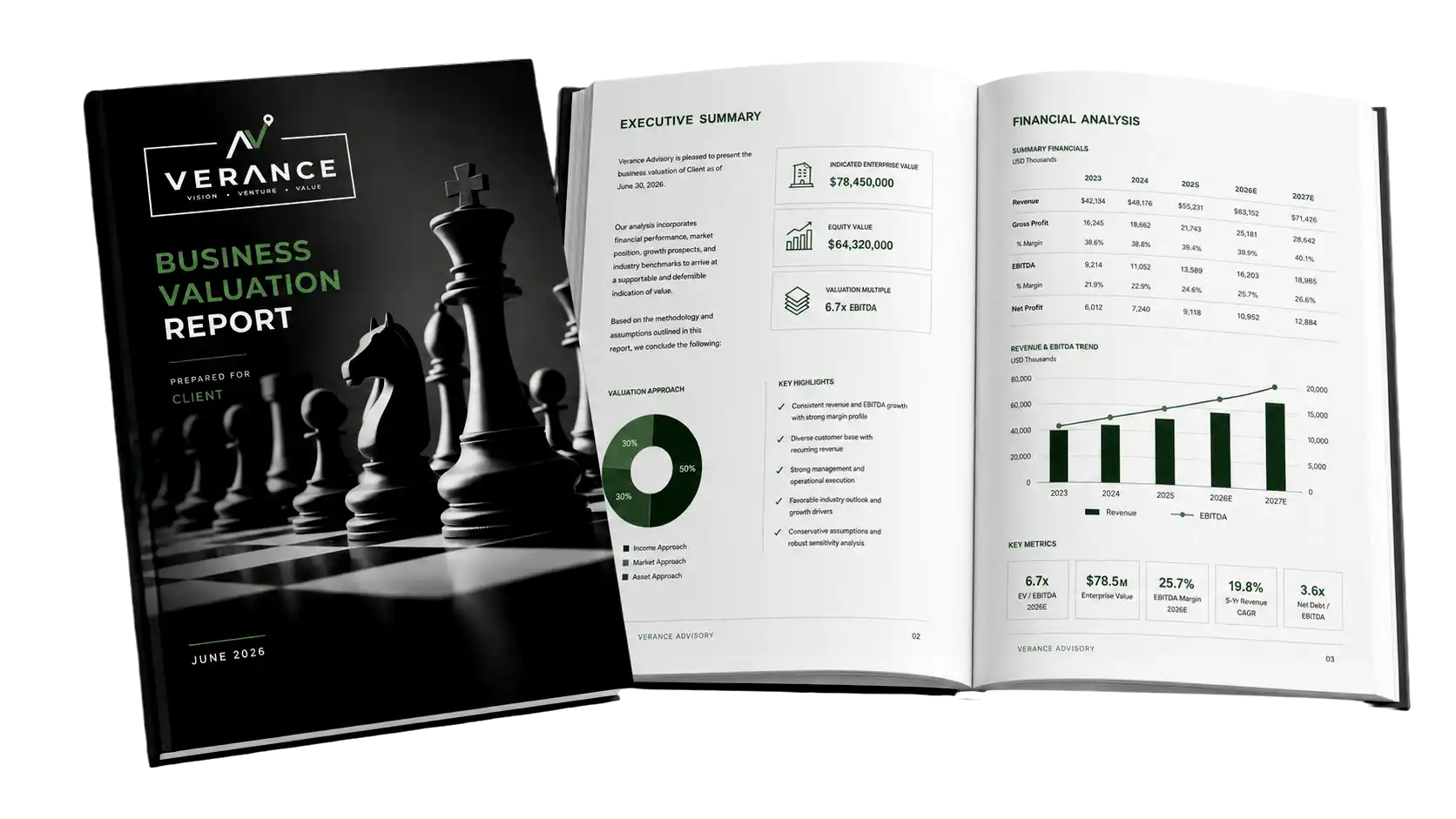
| a. Business Overview | b. Industry Analysis |
| c. Historic Financial Analysis | d. Selected Methodologies |
| e. 20 × 3 Tier Risk Assessment | f. DCF Valuation |
| g. NAV Comparison | h. Earnings Multiple Comparison |
| i. Key Assumptions | j. Valuation Conclusion |
| k. Limitations & Caveats | l. Fair Value Recommendation |
Typical report length:
14 – 18 pages for baseline SMEs | 20 – 25 pages for more complex businesses | 30+ pages for transactions and investment grade reports
| a. Business Overview | b. Industry Analysis |
| c. Historic Financial Analysis | d. Selected Methodologies |
| e. 20 × 3 Tier Risk Assessment | f. DCF Valuation |
| g. NAV Comparison | h. Earnings Multiple Comparison |
| i. Key Assumptions | j. Valuation Conclusion | l. Fair Value Recommendation | k. Limitations & Caveats |
Typical report length:
14 – 18 pages for baseline SMEs | 20 – 25 pages for more complex businesses | 30+ pages for transactions and investment grade reports